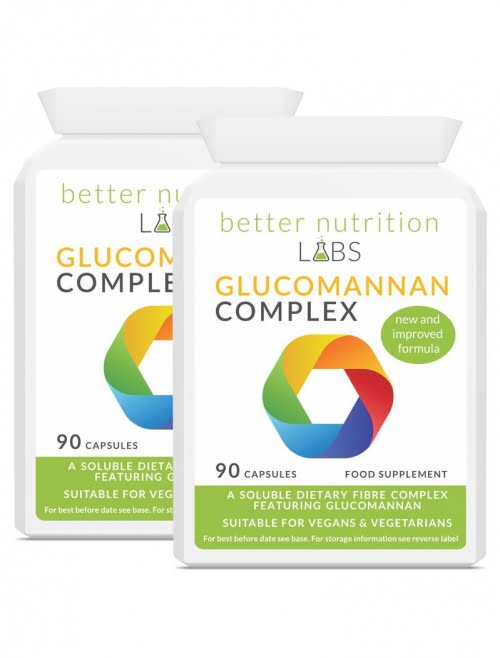
Næringsinnhold per porsjon (2 kapsler):
Glucomannan 90% 780 mg
Acai 04:01 ekstrakt 200 mg
Koffein anhydrouse 150 mg
SAB Digezyme blanding 100 mg
Grønn te ekstrakt 80 mg
L-acetyl L-karnitin 50 mg
Caraluma Fimbriata 25% 40 mg
Papaya frukt 10 mg
Krompicolinate 0,02 mg
Inaktive ingredienser:
Gelatin kapsel. Ikke egnet for vegetarianere
Produsert i Storbritannia til GMP-standarder og ISO9001: 2008 sertifisert kvalitetssikring for Better Nutrition Labs.
Retningslinjer for beste resultat:
Ta to kapsler 30 minutter før måltider med et fullt glass vann.
For best resultat ta to kapsler, to ganger om dagen med hovedmåltidene på tom mage med et fullt glass vann hver gang.
Ikke overskrid anbefalt dose
Forsiktig:
Inneholder koffein.
Å ta dette produktet uten tilstrekkelig væske kan føre til at det eser opp og blokkerer halsen eller spiserøret og kan forårsake kvelning.
Inneholder koffein så unngå å ta dette hvis du har et høyt blodtrykk eller er koffein følsom.
Kosttilskudd bør ikke brukes som erstatning for et balansert kosthold og livsstil.
Hvis du er under 18 år, gravid, ammende eller tar medisiner, bør du oppsøke lege før bruk av kosttilskudd.
Avslutt bruken og kontakt legen din umiddelbart om du får en negativ reaksjon.
Ikke beregnet for personer under 18 år. Unngå dersom du har problemer med å svelge.
Disse påstandene har ikke blitt vurdert av «the Food and Drug Association». Dette er ikke ment å diagnostisere, behandle, kurere eller forebygge sykdom.
Lagring:
Beskytt mot direkte solskinn på et tørt og kjølig sted, utilgjengelig for barn.
Må ikke brukes hvis den indre forseglingen er skadet.
For best før dato se bunnen.
Glucomannan studies
Effect of glucomannan on obese patients: a clinical study
An eight-week double-blind trial was conducted to test purified glucomannan fiber as a food supplement in 20 obese subjects. Glucomannan fiber (from konjac root) or placebo was given in 1-g doses (two 500 mg capsules) with 8 oz water, 1 h prior to each of three meals per d. Subjects were instructed not to change their eating or exercise patterns. Results showed a significant mean weight loss (5.5 lbs) using glucomannan over an eight-week period. Serum cholesterol and low-density lipoprotein cholesterol were significantly reduced (21.7 and 15.0 mg/dl respectively) in the glucomannan treated group. No adverse reactions to glucomannan were reported.
http://www.ncbi.nlm.nih.gov/pubmed/6096282
Konjac-mannan (glucomannan) improves glycemia and other associated risk factors for coronary heart disease in type 2 diabetes. A randomized controlled metabolic trial.
A total of 11 hyperlipidemic and hypertensive type 2 diabetic patients treated conventionally by a low-fat diet and drug therapy participated. After an 8-week baseline, all were randomly assigned to take either KJM fiber-enriched test biscuits (0.7 g/412 kJ [100 kcal] of glucomannan) or matched placebo wheat bran fiber biscuits during two 3-week treatment phases separated by a 2-week washout period. The diet in either case was metabolically controlled and conformed to National Cholesterol Education Program Step 2 guidelines, while medications were maintained constant.
Total and LDL (bad) cholesterol were significantly reduced by 19 ± 2.7% and 29 ± 3.4% during glucomannan treatment compared to 6.3 ± 3.4% and 6.6 ± 5.0% on the control treatment.
An improvement in blood sugar control was observed on the glucomannan 5.6 ± 1.5% (P 0.003), compared with 0.39 ± 1.3% for the control group.
Glucomannan fiber added to conventional treatment may ameliorate glycemic control, blood lipid profile, and sBP in high-risk diabetic individuals, possibly improving the effectiveness of conventional treatment in type 2 diabetes.
http://www.ncbi.nlm.nih.gov/pubmed/10372241
Evaluation of the action of glucomannan on metabolic parameters and on the sensation of satiation in overweight and obese patients
The authors studied the behavior of body weight, blood glucose, total serum cholesterol, and hunger and satiety sensation in 30 patients treated for 60 days with a 1.200 kcal (5040 kj) diet plus either placebo or glucomannane. All the variables considered show that the low-calorie diet plus glucomannane is more effective than the low-calorie diet alone.
http://www.ncbi.nlm.nih.gov/pubmed/7796558
Chronic use of glucomannan in the dietary treatment of severe obesity
Two groups of 25 severely obese patients underwent 3 months of hypocaloric diet therapy either alone or associated with a glucomannan-based fibrous diet supplement (approx. 4 g/die in 3 doses). The comparative analysis of the results obtained in both groups showed that the diet + glucomannan group had a more significant weight loss in relation to the fatty mass alone, an overall improvement in lipid status and carbohydrate tolerance, and a greater adherence to the diet in the absence of any relevant side effects. Due to the marked ability to satiate patients and the positive metabolic effects, glucomannan diet supplements have been found to be particularly efficacious and well tolerated even in the long-term treatment of severe obesity.
http://www.ncbi.nlm.nih.gov/pubmed/1313163
Acai Berry Clinical Studies
Effects of Açai (Euterpe oleracea Mart.) berry preparation on metabolic parameters in a healthy overweight population: A pilot study
In this uncontrolled pilot study, consumption of açai fruit pulp reduced levels of selected markers of metabolic disease risk in overweight adults.
http://www.nutritionj.com/content/10/1/45
Research Shows Brazilian Acai Berry Antioxidants Absorbed by Human Body. Science Codex. 07 October 2008.
Brazilian Berry Destroys Cancer Cells in Lab, UF Study Shows. University of Florida News. 12 January, 2006.
Diet supplementation with acai (Euterpe oleracea Mart.) pulp improves biomarkers of oxidative stress and the serum lipid profile in rats.
http://www.ncbi.nlm.nih.gov/pubmed/20022468
Caffeine studies
Effects of caffeine on energy metabolism, heart rate, and methylxanthine metabolism in lean and obese women.
The magnitude of coffee-induced thermogenesis and the influence of coffee ingestion on substrate oxidation were investigated in 10 lean and 10 obese women, over two 24-h periods in a respiratory chamber.
On one occasion the subjects consumed caffeinated coffee and on the other occasion, decaffeinated coffee. The magnitude of thermogenesis was smaller in obese (4.9 +/- 2.0%) than in lean subjects (7.6 +/- 1.3%). The thermogeneic response to caffeine was prolonged during the night in lean women only. The coffee-induced stimulation of energy expenditure was mediated by a concomitant increase in lipid and carbohydrate oxidation
http://www.ncbi.nlm.nih.gov/pubmed/7485480
Comparison of changes in energy expenditure and body temperatures after caffeine consumption.
Twelve young healthy male volunteers participated in a randomized blind study in which they consumed 150 ml decaffeinated coffee with or without 200 mg added caffeine.
After caffeine consumption the metabolic rate increased immediately with 0.2 +/- 0.2 kJ/min (p < 0.05) and remained elevated for the 3 h during which measurements were taken. Mean total caffeine-induced thermogenesis was 0.30 +/- 0.20 kJ/min, which means a mean increase in the metabolic rate of 7 +/- 4% during 3 h.
http://www.ncbi.nlm.nih.gov/pubmed/7486839
Normal caffeine consumption: influence on thermogenesis and daily energy expenditure in lean and postobese human volunteers.
Single-dose oral administration of 100 mg caffeine increased the resting metabolic rate of both lean and postobese human volunteers by 3-4% (p less than 0.02) over 150 min and improved the defective diet-induced thermogenesis observed in the postobese subjects.
http://www.ncbi.nlm.nih.gov/pubmed/2912010
Effects of caffeine ingestion on NE kinetics, fat oxidation, and energy expenditure in younger and older men.
Green tea studies
Effect of green tea catechins with or without caffeine on anthropometric measures: a systematic review and meta-analysis
Fifteen studies, with 1243 patients in total found on average that green tea catechins with caffeine was associated with statistically significant reductions in BMI, body weight, and waist circumference.
http://ajcn.nutrition.org/content/91/1/73.full
Caralluma Fimbriata studies
Effect of Caralluma fimbriata extract on appetite, food intake and anthropometry in adult Indian men and women.
Caralluma fimbriata is an edible cactus, used by tribal Indians to suppress hunger and enhance endurance. The effect of Caralluma extract was assessed in overweight individuals by a placebo controlled randomized trial. Fifty adult men and women (25-60 years) with a body mass index (BMI) greater than 25 kg/m2 were randomly assigned into a placebo or experimental group; the latter received 1 g of Caralluma extract per day for 60 days.
Waist circumference and hunger levels over the observation period showed a significant decline in the experimental group when compared to the placebo group. While there was a trend towards a greater decrease in body weight, body mass index, hip circumference, body fat and energy intake between assessment time points in the experimental group, these were not significantly different between experimental and placebo groups.
Caralluma extract appears to suppress appetite, and reduce waist circumference when compared to placebo over a 2 month period.
http://www.ncbi.nlm.nih.gov/pubmed/17097761
Papaya studies
The proteolytic activities of chymopapain, papain, and papaya proteinase III
http://www.sciencedirect.com/science/article/pii/0167483885900573
Chromium Studies
Mertz W. Chromium occurrence and function in biological systems. Physiol Rev 1969;49:163-239. http://www.ncbi.nlm.nih.gov/pubmed/4888391
Mertz W. Chromium in human nutrition: a review. J Nutr 1993;123:626-33. http://www.ncbi.nlm.nih.gov/pubmed/8463863
Mertz W. Interaction of chromium with insulin: a progress report. Nutr Rev 1998;56:174-7.
Porte Jr. D, Sherwin RS, Baron A (editors). Ellengerg & Rifkin’s Diabetes Mellitus, 6th Edition. McGraw-Hill, New York, 2003. http://www.ncbi.nlm.nih.gov/pubmed/9656727







Omtaler
Det er ingen produktomtaler ennå.